
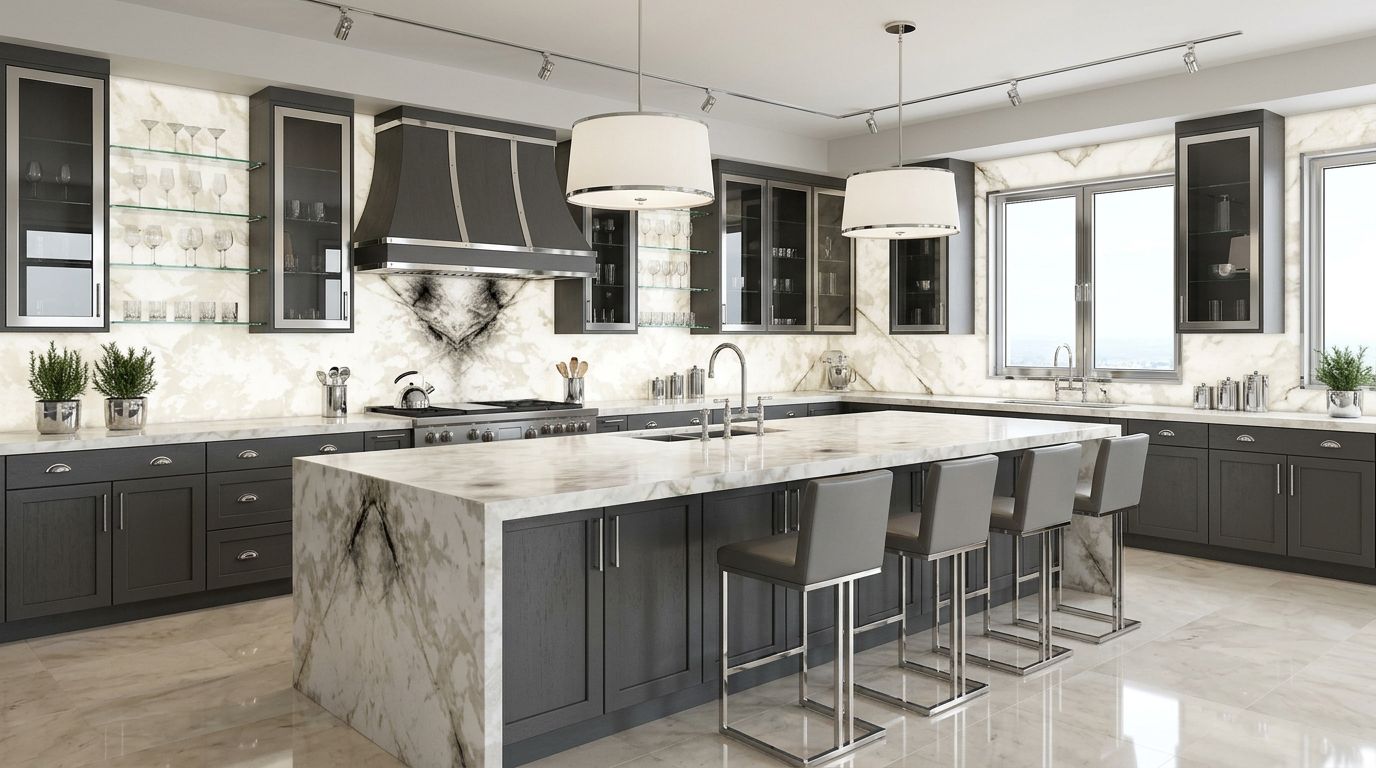
Cristallo Bianco Quartzite vs White Marble: How They Compare
If you want a bright white natural stone, the choice often comes down to white marble or white quartzite. Cristallo Bianco sits right in the middle of that decision. It has a bright, crystal-white base mixed with off-white, and it is one of the brightest, whitest natural quartzites, with an exceptionally clean, modern look. Its high translucency also makes it one of the best Cristallo options for backlighting.
This guide explains how Cristallo Bianco compares with white marble for everyday use, where translucent quartzite makes the most sense, how to care for it honestly, and what to check before you choose your slab.
Quick Product Facts
The Actual Slab

Every natural quartzite slab is unique, and translucency can vary across a slab and from one slab to the next. That is why we recommend seeing your slab in person, ideally with light behind it if you plan to backlight it.
Color, Veining and Character
Cristallo Bianco is about brightness rather than bold contrast. The crystal-white base and soft off-white areas give it a clean, luminous surface that keeps a kitchen or bath feeling open and light. The polished finish reflects light and brings out the crystalline depth of the stone.
Because the look is calm and white, it suits modern and minimal interiors, and it is a natural choice for buyers who want the look of white stone without choosing an engineered material.
Why Choose Quartzite?
Quartzite is a natural stone formed when sandstone is transformed by heat and pressure, so it is made mostly of quartz. That is the main reason it behaves differently from marble, even when the two look similar.
Cristallo Bianco vs white marble
- Hardness and scratches: quartzite is generally much harder than marble. Cristallo Bianco’s quartzite hardness and heat and scratch resistance are why it suits busy kitchen countertops and islands.
- Acids and etching: marble is made of calcite, so lemon juice, wine or vinegar can etch it quickly. Quartzite is far more resistant, but “resistant” is not “immune”: wipe acidic spills promptly and keep the stone sealed.
- Staining: both are natural stones with some porosity. Sealing helps either one resist stains; marble usually needs it more often.
- Look: white marble often has softer, more pronounced veining. Cristallo Bianco offers a brighter, cleaner white with crystalline depth.
- Light: most marble is not chosen for backlighting. Cristallo Bianco’s high translucency makes it one of the best Cristallo options for backlit designs.
Some articles claim quartzite never needs sealing or cannot etch at all. We prefer to be accurate: quartzite is the more forgiving choice for a working kitchen, but it still benefits from sealing and sensible care.
Applications and Design Ideas
- White kitchen countertops: a bright, clean work surface that keeps the kitchen feeling light.
- Kitchen islands: the large slab size gives room for generous islands with fewer seams.
- Bathroom vanities: a crisp white vanity top for a spa-like, modern bath.
- Backlit features: a backlit island front, bar or feature wall lets the translucency glow. The lighting system is designed and installed by your fabricator and lighting professional.
- Book-matched installations: Cristallo Bianco is also offered as a two-slab book-matched pair for a mirrored layout on a wall or island.
Pairing tips: white or warm wood cabinetry keeps the look soft; matte black or brushed brass fixtures add definition. For backlit pieces, warm LED tones bring out a softer glow than cool white light.
Care and Maintenance
- Seal the quartzite after installation and reseal as your fabricator recommends.
- Wipe up acidic spills such as citrus, wine and vinegar promptly.
- Clean with a soft cloth and a pH-neutral stone cleaner; avoid harsh or abrasive products.
- Use cutting boards, and use trivets under hot pans to protect the surface and any sealer.
Buyer’s Checklist
- See the actual slab in person: color and translucency vary from slab to slab.
- If you plan to backlight, ask to view the slab with light behind it.
- Confirm the slab size (133 x 78 in) works for your layout, or ask about the book-matched pair.
- Plan seam locations and any lighting cut-outs with your fabricator.
- Decide whether marble’s softer look or quartzite’s durability matters more for your space.
- Confirm current availability with our team before you plan your project.
Frequently Asked Questions
Is Cristallo Bianco quartzite better than marble for a kitchen?
For a busy kitchen, quartzite is usually the more forgiving choice: it is harder than marble and far more resistant to etching and scratches. Marble can still work in kitchens if you are comfortable with regular sealing and a lived-in patina.
Can Cristallo Bianco be backlit?
Yes. Its high translucency makes it one of the best Cristallo options for backlighting. Translucency varies by slab, so view your slab with light behind it before you commit.
Does Cristallo quartzite need sealing?
Yes, sealing is recommended. Quartzite is dense, but like any natural stone it benefits from a sealer to help resist stains. Your fabricator can recommend a sealer and schedule.
Will lemon juice or wine etch Cristallo Bianco?
Quartzite is far more resistant to acids than marble, but no natural stone is completely immune. Wipe acidic spills promptly and clean with a pH-neutral stone cleaner.
Where can I see Cristallo Bianco in person?
Cristallo Bianco is in stock at our Westminster showroom. Visit US Stone Group in Westminster, CA; we serve Orange County and all of Southern California.
Text or call us, request a quote, or explore the slab to discuss your project. See Cristallo Bianco in person at our Westminster showroom.
No responses yet