
Labradorite Countertops: Design Ideas for Kitchens, Baths and Statement Walls
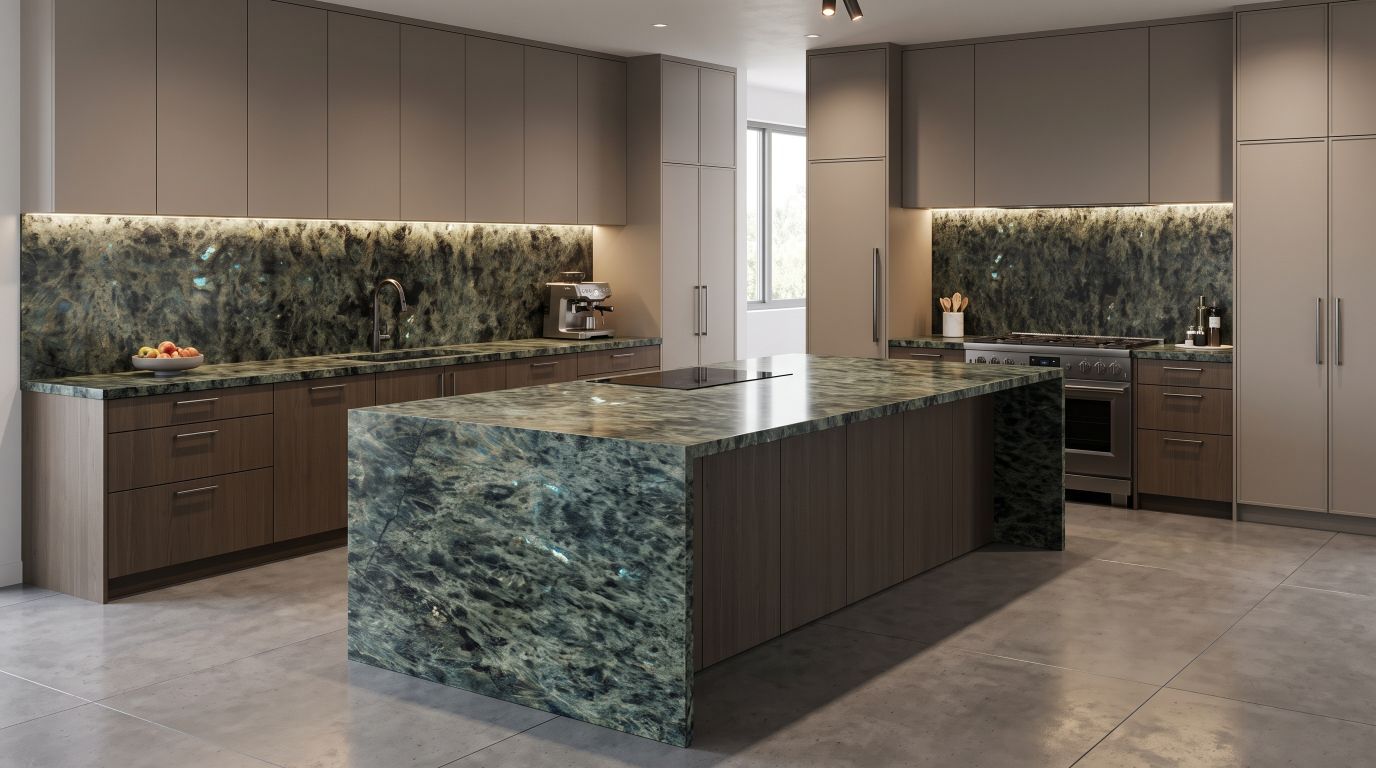
Few stones change as you walk past them. Labradorite blends deep gray, black, blue and green, and as the light and your viewing angle shift, iridescent blue and green flashes appear across the surface. On a kitchen island, a bar top or a feature wall, that movement turns a hard surface into the centerpiece of the room.
This guide is about where labradorite works best and how to design around it: the rooms and surfaces that show it off, the cabinets, metals and lighting that pair well, honest care advice and what to check before you choose your slab. Labradorite is in stock at our Westminster showroom, so you can see the flash for yourself.
Quick Product Facts
The Actual Slab
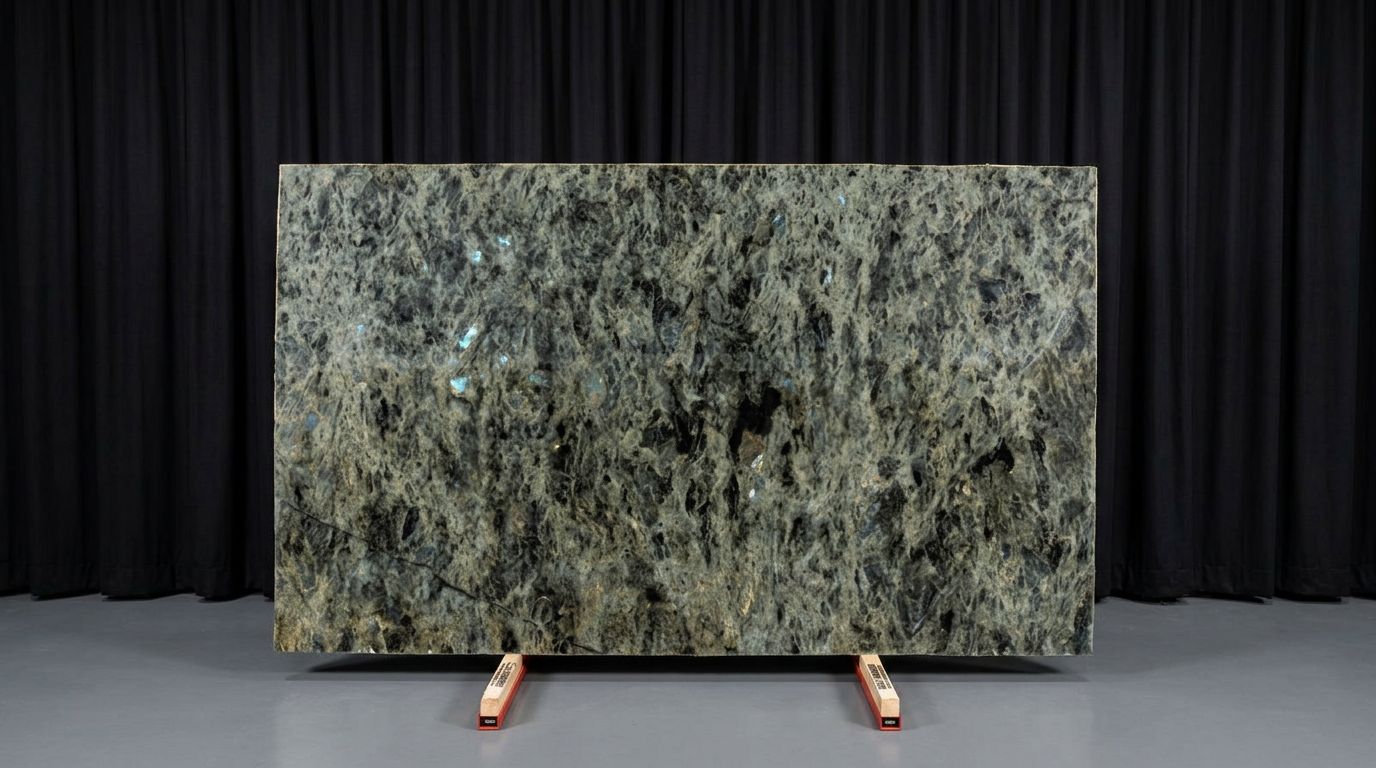
A photo can only capture the flash from one angle and in one light. In person, the blue and green come and go as you move, and every slab shows its own pattern, so we always recommend seeing the actual slab before you commit.
Color, Flash and Character
The base of labradorite is dark and moody: deep gray and black with shimmering crystalline structures. The famous blue and green color is not a pigment on the surface. It comes from the way light reflects inside the stone’s crystals, which is why it appears at some angles and disappears at others. Geologists call this effect labradorescence.
That has two practical consequences for design. First, the flash depends on light, so the same slab looks calm and dark from one spot and electric from another. Second, the polished finish brings out depth and reflection, which helps the color read clearly. Plan your lighting with the stone in mind, and view your slab under more than one light source before deciding where each piece will go.
Why Choose Labradorite?
Labradorite gives you one of the most distinctive looks in natural stone. Sold commercially as granite, it offers the hardness and the heat and scratch resistance needed for functional surfaces, so it can be used as a working bar top or island, not only as a decorative panel.
It also helps to know the trade-offs. The mineral labradorite is a feldspar, generally rated around 6 to 6.5 on the Mohs hardness scale, and its crystals can split along natural planes. In practice, sharp corners, sink cutouts and long unsupported overhangs deserve extra care during fabrication, and a softened or eased edge profile is a sensible choice for busy areas. Like most natural stone, it benefits from sealing and sensible everyday habits. With those in mind, it is a durable and rewarding surface.
Applications and Design Ideas
Kitchen islands
The island is where labradorite shines. It is the surface people walk around, lean on and look at from every side, so the flash keeps changing through the day. Let the island be the single statement and keep the perimeter counters and backsplash quieter.
Bar tops and home bars
A bar top is a perfect size for a dramatic stone. Under-cabinet or pendant lighting over a polished labradorite bar brings out the blue and green in the evening, exactly when a bar is in use.
Bathroom vanities
A labradorite vanity top turns a powder room or primary bath into a jewel box. Pair it with a simple undermount sink and plain wall tile so the stone stays the focus.
Feature walls and living spaces
On a feature wall or fireplace surround, a large polished slab reads almost like artwork. Grazing light from above or the side makes the iridescence move as you cross the room.
Reception desks and commercial spaces
For hospitality, retail and offices, a labradorite reception desk or bar front is a memorable first impression that also holds up to daily use.
Pairing tips: white, light gray or soft greige cabinets let the dark stone stand out; deep navy, charcoal or black cabinets create a moody, tone-on-tone look. Warm wood softens the drama. Brushed brass and gold pick up warmth in the stone, while matte black and polished nickel keep it sleek. Directional lighting, such as pendants, under-cabinet strips or wall grazers, shows the flash far better than flat overhead light.
Care and Maintenance
- Seal the stone after installation and reseal as your fabricator recommends; a simple water-drop test shows when it is time.
- Clean with warm water or a pH-neutral stone cleaner and a soft cloth; avoid bleach, ammonia, vinegar and abrasive pads.
- Wipe up spills such as wine, oil, coffee and citrus promptly.
- Use cutting boards, and trivets under very hot pans, to protect the polish and avoid sudden temperature shocks.
- Take care with heavy objects near edges and corners.
Buyer’s Checklist
- See the actual slab in person and look at it from several angles and in different light.
- Confirm the slab size (130 x 76 in) works for your island, bar or wall.
- Decide where you want the strongest flash and plan seams and cut pieces with your fabricator.
- Choose an edge profile and support for overhangs suited to the stone.
- Plan your lighting at the same time as the countertop.
- Confirm current availability with our team, and have installation handled by a qualified fabricator.
Frequently Asked Questions
Is labradorite good for kitchen countertops?
Yes, with sensible care. It offers the hardness and heat and scratch resistance needed for functional surfaces, and it is especially popular on kitchen islands and bar tops where its flash can be seen from every side. Seal it, use cutting boards and trivets, and ask your fabricator about edge profiles.
Does labradorite need sealing?
Like most natural stone, it benefits from sealing. Your fabricator can recommend a sealer and how often to reapply it based on how you use the surface.
Why does labradorite flash blue and green?
The color comes from light reflecting inside the stone’s crystals, an effect called labradorescence. That is why it changes with the light and your viewing angle, and why each slab looks different.
How much does a labradorite countertop cost?
Cost depends on the size of your project, edges, cutouts and installation. Request a quote and our team will help you plan your project.
Where can I see labradorite slabs?
Visit the US Stone Group showroom at 14731 Goldenwest St, Westminster, CA. We serve Orange County, Los Angeles, San Diego and the Inland Empire.
Text or call us, request a quote, or explore the slab to discuss your project. See Labradorite in person at our Westminster showroom.
No responses yet