
Calacatta Gold Porcelain Slab vs Quartz Countertops: Which Is Right for Your Kitchen?
If you love the look of Calacatta Gold marble but not the upkeep, two materials usually end up on your shortlist: a marble-look porcelain slab and quartz. Both are low-maintenance and both can give you a bright white kitchen with soft veining. They are made very differently, though, and those differences show up in how they handle heat, edges, sunlight and everyday wear.
This guide compares the two honestly, using our Calacatta Gold porcelain slab as the example, so you can decide which surface fits the way you cook and live.
Quick Product Facts
The Actual Slab

Calacatta Gold is in stock at our Westminster showroom. Seeing the full slab in person is the best way to judge how the veining will fall across your island or perimeter counters.
Color, Veining and Character
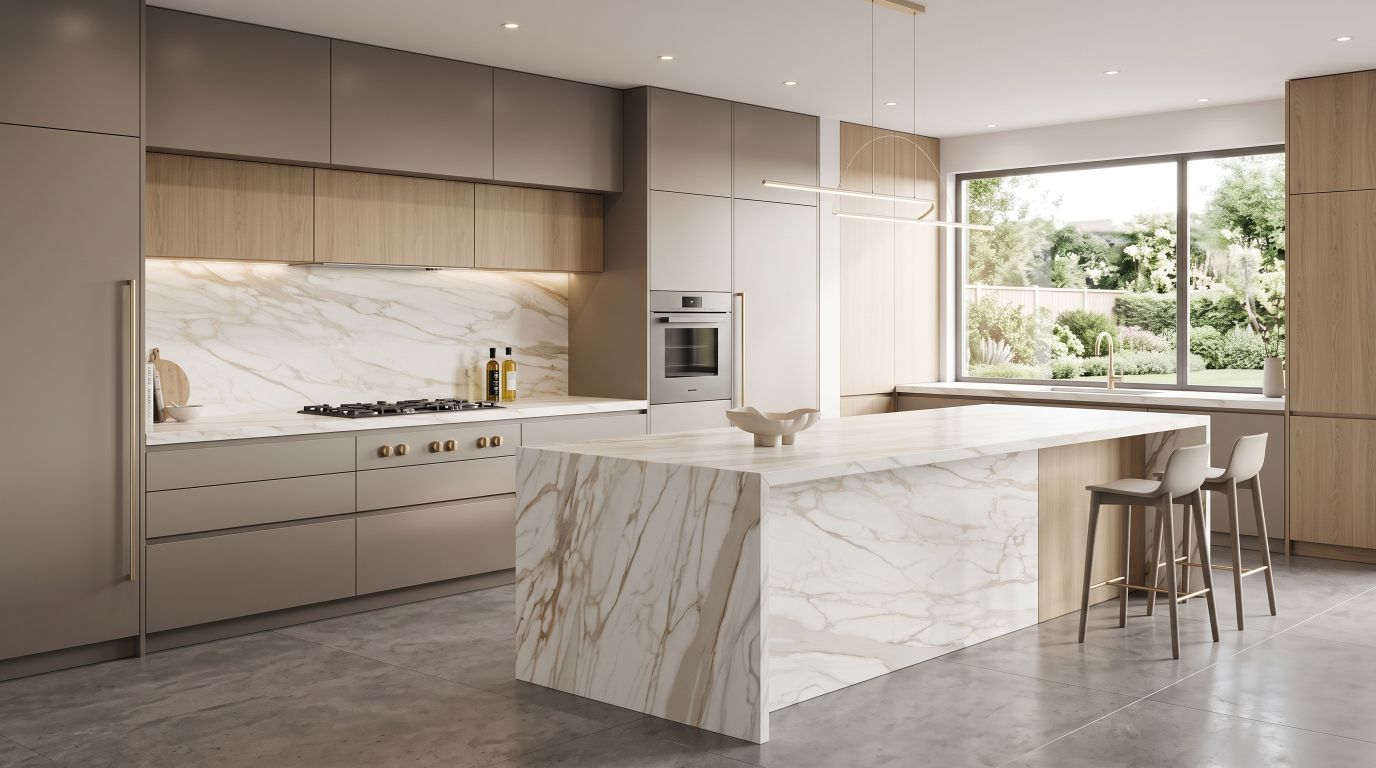
Calacatta Gold pairs a soft white field with subtle gold veins, the look of classic Calacatta Gold marble. The veining is gentle rather than dramatic, so the surface feels warm and luminous without overpowering cabinetry or hardware. The satin finish softens reflections, which keeps glare down under pendant lights and gives the slab a calm, honed-style feel.
Because the pattern is part of a large-format slab, a 126-inch length can cover long runs and many islands with fewer seams than smaller pieces would need.
Why Choose Porcelain? How It Compares with Quartz
Porcelain slabs are made from fine clay and minerals fired at very high temperatures. Quartz countertops are engineered stone: crushed quartz bound together with resin. That one difference, fired ceramic versus a resin binder, explains most of the trade-offs below.
Heat
Porcelain handles heat well, which is why many cooks like it next to a range. Quartz is also durable, but its resin can scorch or discolor under hot cookware, so trivets are a must. We still recommend trivets on any countertop as a good habit.
Stains and sealing
Both surfaces are non-porous and neither needs sealing. Calacatta Gold porcelain is stain and scratch resistant, and it avoids the etching and sealing that come with real marble, so lemon juice, wine and coffee are far less of a worry than on natural Calacatta.
Scratches and everyday wear
Both materials resist everyday scratches well. Sources disagree on which is harder in daily use, and the honest answer is that neither should be used as a cutting board. Use boards for knives and lift, rather than drag, heavy pots.
Edges and impact
This is quartz’s strongest advantage. Thin porcelain is more brittle at edges and corners, and a hard knock from a heavy pan can chip it; chips are usually harder to hide than on quartz, which can often be repaired with a color-matched filler. Quartz also supports a wider range of edge profiles. Porcelain usually looks best with a simple eased or mitered edge, and a mitered edge can create the look of a thicker slab.
Sunlight and outdoor use
Porcelain is generally UV-stable, which makes it a common choice in sunny rooms and outdoor settings. Many quartz products are recommended for indoor use only, because the resin can fade or yellow in strong sun. If your kitchen gets direct afternoon light, ask about this for any quartz you consider.
Fabrication
Porcelain slabs need a fabricator who knows the material: careful cutting, supported overhangs and rounded inside corners at sink cutouts. A good fabricator matters with every material, but especially with porcelain.
The short version: choose porcelain if heat resistance, UV stability and a true marble look matter most; choose quartz if you want maximum edge-profile options and easier chip repair.
Applications and Design Ideas
- Kitchen countertops and islands: the slab’s 126-inch length suits long islands where you want the veining to run uninterrupted.
- Full-height backsplashes: carrying the same slab up the wall gives a seamless, marble-look kitchen.
- Bathroom walls and floors: soft white and gold brighten a primary bath without the maintenance of natural marble.
- Waterfall ends: a mitered waterfall lets the gold veining wrap down the side of an island.
Pairing tips: brushed brass or warm gold hardware picks up the veining; white oak, greige or deep green cabinetry adds contrast while keeping the room warm.
Care and Maintenance
- Wipe daily with warm water and a mild, non-abrasive cleaner.
- No sealing is needed for the porcelain slab.
- Use cutting boards rather than cutting directly on the surface.
- Protect edges and corners from hard knocks with heavy pots and cast iron.
- Use trivets as a good habit, especially under very hot cookware.
Buyer’s Checklist
- Decide what matters most: heat and UV resistance (porcelain) or edge options and easy repairs (quartz).
- Confirm the slab size (126 x 63 x 0.47 in) works for your layout and island length.
- Choose an edge detail suited to porcelain, such as eased or mitered.
- Hire a fabricator experienced with porcelain slabs.
- See the Calacatta Gold slab in person and confirm current availability with our team.
- Plan seam locations so the veining flows across the counters.
Frequently Asked Questions
Porcelain vs quartz countertops: which is better for a kitchen?
Neither is better for every kitchen. Porcelain is the stronger choice for heat resistance, sunlight and a convincing marble look; quartz offers more edge profiles and easier chip repair. Think about how you cook and where the counters sit in the room.
How thick is the Calacatta Gold porcelain slab?
The slab listed on our site is 126 x 63 x 0.47 in (about 12 mm) with a satin finish. A mitered edge can give the look of a thicker countertop.
Does porcelain need sealing like marble?
No. Calacatta Gold porcelain is stain and scratch resistant and avoids the etching and sealing that come with real marble.
Can Calacatta Gold porcelain be used in bathrooms?
Yes. Besides kitchen countertops and islands, it works well on bathroom walls and floors.
How much do porcelain countertops cost?
Cost depends on your layout, edges, cutouts and installation. Request a quote and our team will help you price your project with Calacatta Gold.
Text or call us, request a quote, or explore the slab to discuss your project. See Calacatta Gold in person at our Westminster showroom.
No responses yet